1. Choose an agreed focus
Start with the athlete’s own goal. Browse the source guide and decide whether the educational practice fits your work together.
 MindEdge
Educational resources and practical prompts to explore alongside your own work with athletes. Choose what fits your role, the person, and the agreed goal.
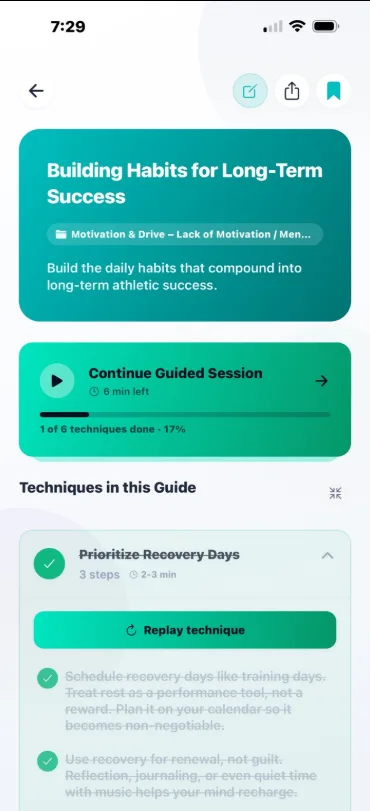
Start with the athlete’s own goal. Browse the source guide and decide whether the educational practice fits your work together.
Build a simple weekly practice plan or print a routine. Avoid including identifying client information in public tools or shared team records.
Invite the athlete to reflect on what they tried, what was useful and what they would change. Adapt the next step using your own professional judgment.
MindEdge is not a diagnostic tool, clinical record system, or replacement for care. Its AI coach produces automated responses and can make mistakes. Public practice tools are educational. A coach account provides a shared team workflow; it does not create a separate clinical workspace.
Decide suitability under your own professional obligations. Agree on sharing before using a team dashboard, and keep confidential clinical documentation in your appropriate system.
How source and review information works →Browse the educational guides and free tools, then choose a practice that fits your professional role and the athlete’s goals. You can use printable routines or reflection prompts as an agreed activity between conversations. Decide suitability yourself; MindEdge does not replace your assessment or care.
No. MindEdge is a mental performance and self-improvement app. The mindset assessment is a reflection tool, not a diagnosis. The coach dashboard is not an electronic health record, and it should not be used to store confidential clinical notes.
Yes. The public breathing timer, routine builder, self-talk tool, reflection tool, team huddle planner and weekly practice planner work without a MindEdge account. Inputs in the builders remain in the page. Copy or print a plan if you want to keep it.
Open the source guide from an answer or resource card. Guides show their source material and the review details available for that version. The editorial policy explains how MindEdge handles professional review and revisions. This answer hub links back to those original pages.
Yes. Public builders have Print / save PDF controls. For the app’s full content library, an authorized coach account can export a program or technique from Programs & techniques. Agree with the athlete how they want to use and store their copy.
Explain who will have access, what the athlete is choosing to share, and how you intend to use it. Keep clinical records in your own appropriate system. Use your professional obligations and local requirements to decide whether a shared team setup is appropriate for that athlete.
No. The in-app AI coach produces automated responses. A session requested with Lesley is a separate human service, arranged and confirmed by email. AI output can be mistaken and does not establish a professional care relationship.
Use the session-request page and choose Professional collaboration. Share your country, timezone and scheduling preferences. Keep client health information out of the public request; the initial reply can establish a suitable way to discuss the collaboration.
Request a session, team workshop or professional collaboration. Availability, format and fees are confirmed before booking.
Request a session →Use this worksheet to organize an educational practice agreed with an athlete. Decide suitability within your own professional role. It is not a clinical form, a validated outcome measure or a place to record confidential client information.
Ask which sport situation the athlete wants to explore and what a useful action would look like. Agree on whether they wish to share the resulting worksheet. Do not enter names, diagnoses or sensitive notes into public tools.
Specify the context, the action and a manageable opportunity to try it. For example: before receiving in a passing drill, look for one open option. Leave room for the athlete to adapt or stop the exercise.
Ask what was attempted, what the athlete noticed and what they would change. This record cannot establish treatment response. Keep clinical assessment and confidential documentation in your appropriate professional systems.
An athlete wants to return to the next task after an error. Together, you choose a familiar drill and the cue “Find my role.” At the next conversation, ask about one actual attempt rather than treating a mood rating as evidence of clinical progress.
Print this card and fill it in privately. Leave out names and sensitive health information.
Agreed sport situation (no identifying details)
One observable action
Cue in the athlete’s own words
When and where to try it safely
What I noticed, without private health details
Next choice: keep, change or stop
Original MindEdge educational exercise added September 12, 2026. Reviewed and approved by MindEdge. It is not a validated assessment, diagnosis or treatment. Follow your sport’s safety rules and seek qualified support for persistent distress.
Background reading: AASP: the coach’s role in pre-performance routines. The worksheet and examples are MindEdge’s own practice prompts, not a tested protocol from the source. Editorial standards.