A plan athletes can follow
Guided programs break confidence, focus and pressure into techniques athletes can practise. Short resets and games support the routine.
 MindEdge Business plan
BUSINESS PLAN & PITCH / 11 November 2026
Guided mental performance programs and practical techniques for athletes. A connected library and dashboard for coaches. Built in Canada, for individual athletes and teams.
Current product. Founder-reported traction. Clearly labelled future plans and financial assumptions.
01 / The opportunity
Mental performance and wellbeing deserve a place in an athlete's training. MindEdge turns that intention into guided programs and practical techniques.
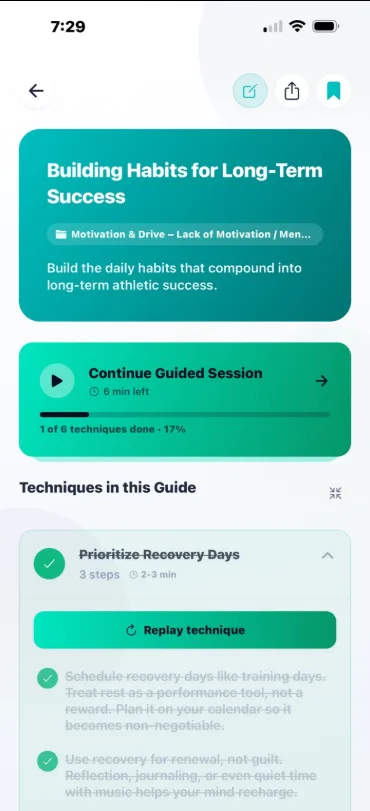
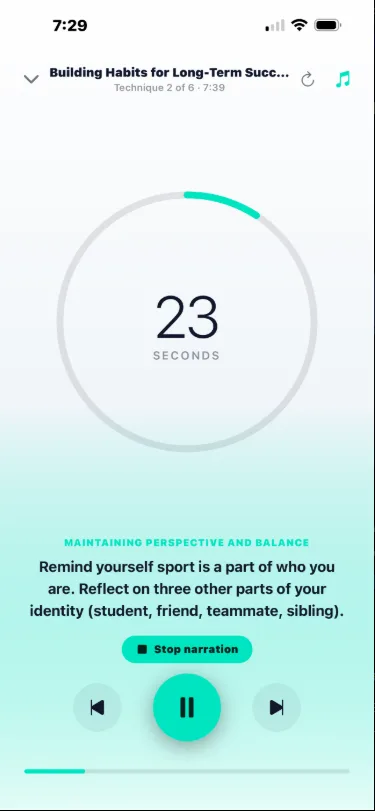
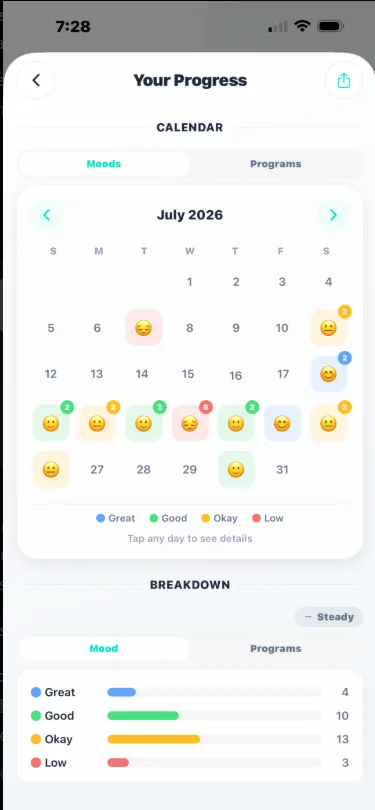
Guided programs break confidence, focus and pressure into techniques athletes can practise. Short resets and games support the routine.
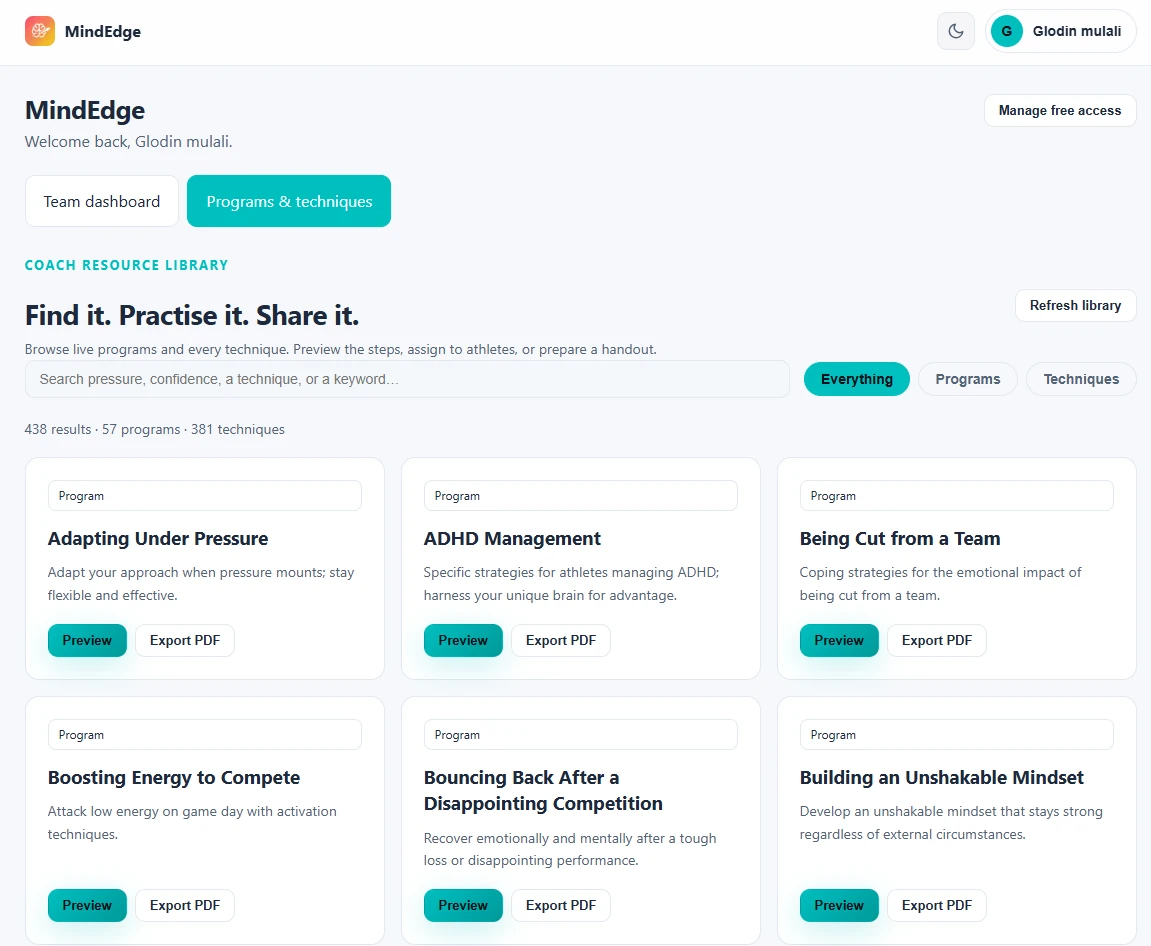
Browse the library, preview a technique, assign training, and follow completion. Export a resource as a handout.
The business combines individual app-store subscriptions with paid team contracts. The initial focus is organized sport: coaches and clubs that can introduce a repeatable mental practice to an entire roster. MindEdge is a mental performance and wellbeing tool; it does not diagnose conditions or replace clinical care.
02 / Why this matters
Athletes face pressure and fear of failure. Access to practical mental support has not kept pace with the need.
Different questions in the same cohort. This is not an app conversion or effectiveness measure.
Cited self-imposed pressure as a source of sport stress in a survey of 200 U.S. high-school athletes aged 16-17.
Cited fear of failure in the same study. These are respondent findings, not estimates for all athletes.
In SportsAid's 2023 survey of 379 UK athletes, 75% rated mental health resources, tools and sessions from SportsAid specifically to help their sporting performance as quite or extremely useful; 46% reported some or a lot of access to sport psychology support. These answer different questions. The NCAA's October 2025 SNAP survey also found performance pressure had harmed mental health in the previous month for 40% of respondents in women's sports and 19% in men's sports. That voluntary survey had 6,789 respondents across 153 Division I schools and an estimated 12% response rate. These studies support the need for accessible support, not a claim that MindEdge improves outcomes.
Sources: 1. Health Psychology Research (2023): Prevalence of stress amongst high school athletes · 2. SportsAid athlete survey (2023) · 16. NCAA SNAP Study: October 2025 survey, pp. 2, 5 and 65
03 / The product today
Live on iOS and Android, with a website and coach tools. Seven app languages help athletes practice in familiar words.
Choose a goal or moment, follow the guided session, and work through practical techniques at your own pace.
Coaches preview programs and techniques, assign them to athletes, and export a PDF handout for a session.
Structured programs and techniques are the core of MindEdge: practical training for confidence, focus, pressure and setbacks. The same library supports independent athlete practice and coach-led team work. Breathing, visualization, four mental games, check-ins, progress reports and AI coaching provide additional ways to practise. Coaches can follow assigned completion; private AI conversations are not a team feed. The app supports English, French, Spanish, German, Simplified Chinese, Japanese and Korean. MindEdge supports mental performance and wellbeing; it does not replace clinical care or claim proven performance outcomes.
Sources: 3. MindEdge product and founders
04 / Our starting point
Hundreds of athletes onboarded in Canada.
A licensed counsellor specializing in athletes and a former Olympic Trials swimmer, Lesley brings professional and lived experience of the pressures athletes face.
An industrial engineer (EIT), product builder, First Team All-Canadian receiver and Team Canada gold medalist, Glodin connects athlete experience with product development.
Founder-reported traction, as of November 2026: hundreds of athletes onboarded in Canada through team relationships and mental performance sessions, with ongoing feedback and product use. This is not a count of paid subscribers, monthly active users, or contracted teams. Exact revenue, retention, and paid conversion are not yet available for publication. The next priority is to measure cohorts: invited, activated, active at four weeks, paid, and renewed. Personal onboarding is an early learning and distribution advantage; a repeatable partner playbook must eventually reduce reliance on founder time.
Sources: 3. MindEdge product and founders
05 / Market context
Organized sport gives MindEdge a practical route to athletes through the people who already support them.
Grand View Research. Adjacent category; not MindEdge's addressable market.
People aged 15+ who played a sport in the previous year, in Statistics Canada's 2023 survey. Includes recreational participation.
NCAA championship-sport teams in 2024-25, with 554,298 student-athletes across three divisions.
Citizens exercising several times a week in the 2026 Eurobarometer. A further 9% exercised almost daily. Broad activity context.
Grand View Research estimates the broad mental-health apps market at USD 7.48 billion in 2024 and forecasts USD 17.52 billion by 2030. This includes general wellness and clinical-use categories; it is not MindEdge's addressable market. Canada provides the initial relationship base, with US teams and European clubs as expansion routes to test. The participation statistics have different populations and definitions; they cannot be added together or treated as paying customers. Build a sales model from qualified clubs, decision-makers, contract value, conversion and renewals. A reliable public market-size estimate for athlete mental performance software was not identified.
Sources: 4. Grand View Research: Mental Health Apps Market (2025 report) · 5. NCAA: Record participation in 2024-25 · 6. European Commission: Sport and physical activity, Eurobarometer (2026) · 7. Statistics Canada: Participation in Canadian society through sport and work (2023)
06 / Competitive landscape
Established specialists already serve athletes and teams. Large wellbeing brands also compete for attention.
| Company | Public offering | Position / relevance |
|---|---|---|
| MindEdge | Guided programs and techniques, a coach resource library, PDF handouts, assignments, games and seven app languages. | Combines individual practice with team delivery and founder-led education. Current product; differentiation must be validated. |
| Champion's Mind | Structured mental training and a coach dashboard. | Shows that athlete subscriptions and team management are established categories. |
| Restoic | Team programs, onboarding, and a SmartCoach dashboard. | A close comparison for combining human onboarding with ongoing practice. |
| Sync | Athlete sessions, team licences, and coach progress tracking. | Reports 15,000+ athletes on its site; company-reported adoption, not paid users. |
| Rewire Fitness | Readiness, recovery, breathing, and cognitive training. | Competes around performance routines and training readiness. |
| Headspace | A large general mindfulness and wellbeing platform. | An adjacent attention and subscription competitor, beyond sport-specific tools. |
MindEdge's position is the combination: structured programs athletes can follow, practical techniques coaches can assign or print, interactive practice and multilingual delivery. Competitors also offer training, dashboards and onboarding; none of those features alone is unique. The next commercial test is whether teams start, keep using and renew this combined workflow. There is no reliable niche market-share dataset to establish dominance or its absence. This comparison describes public offerings, not a quality ranking or proof that competitors lack an unlisted feature.
Sources: 3. MindEdge product and founders · 8. Champion's Mind: Features · 9. Restoic for Teams · 10. Sync: Mental training for athletes and teams · 11. Rewire Fitness: Athletes · 12. Headspace
07 / Business model
Individuals subscribe through app stores. Teams purchase contracted access for their roster and coaches.
Localized iOS and Android checkout. Current prices and available plans are shown in the stores; no new public price is announced here.
Custom proposals based on roster size, contract length, onboarding, and the support required. Team codes make access straightforward.
A potential network of qualified local professionals, team sessions, and athlete bookings. Future development; excluded from base-case revenue.
Start team sales with a defined pilot, an agreed decision date, a named coach champion, and written success criteria. Convert successful pilots into season or annual contracts. Distinguish software access from optional facilitated sessions so service delivery does not quietly consume subscription margin. Define seats, renewal terms, support, permissions, and athlete transitions up front. Maintain individual access and store subscription restoration alongside team entitlements. Final pricing should be tested against delivered value and willingness to pay, not set from a competitor's cheapest plan.
08 / Go to market
Today's engine is organic content and direct relationships. Paid growth comes after retention and economics are understood.
Instagram, TikTok, and Facebook: carousels and reels. Current founder-reported cadence is 3-4 carousels a day.
Meet the team, discuss mental performance, onboard athletes, and give the coach one clear first assignment.
Later: athlete and practitioner creators, referrals, and controlled Meta and TikTok campaigns.
Track each step: content view to website visit, store visit, install, first completed practice, four-week return, paid conversion, and renewal. Use tagged links and cohort reporting, with appropriate consent. For teams, track qualified conversations, pilots, activation, coach engagement, signed contracts, and renewal. Publish fewer stronger pieces if volume is not producing useful engagement. Reuse athlete questions to improve content and onboarding. Introduce paid campaigns with a capped test budget only when contribution and retention can support an explicit acquisition-cost ceiling; impressions and installs alone are not a growth strategy.
09 / Planning economics
All figures below are illustrative CAD planning assumptions. They are not prices, offers, forecasts, or current results.
| Scenario | Teams | Paid individuals* | Gross revenue | Contribution** |
|---|---|---|---|---|
| Early scale | 50 | 1,000 | $240,000 | $139,500 |
| Growing network | 200 | 5,000 | $1,050,000 | $609,500 |
| Expanded reach | 500 | 15,000 | $2,850,000 | $1,652,500 |
*Separate paying individuals; team-covered athletes are excluded. **After assumed fees, variable delivery and first-year team onboarding. Before fixed costs, acquisition, tax and refunds; not profit.
Change a planning input to see its effect. These figures do not set MindEdge's prices. The PDF retains the original illustrative assumptions.
Gross = teams × annual contract + separate individuals × annual revenue.
Contribution = gross − channel fees − (team athletes + individuals) × delivery cost − team onboarding.
Team contract revenue plus individual subscription revenue. Team-covered athletes are not counted again as paid individuals.
Include store fees, payment fees, delivery costs, and onboarding before evaluating acquisition spend.
The example assumes CAD 3,000 per team annually, 30 athletes per team, CAD 90 annual gross revenue per separate paid individual, 15% blended individual store fees, 3% team payment fees, CAD 25 annual variable delivery cost per covered athlete, and CAD 400 first-year onboarding cost per team. These are editable hypotheses, not researched operating costs. Actual platform terms vary by program, region and eligibility. Contribution excludes salaries, acquisition, tax, refunds, travel, fixed hosting, legal, insurance, and other overhead. It is not profit. Future session or marketplace revenue is excluded. Larger rosters, AI usage and human support must be measured before signing uncapped contracts.
Sources: 13. Apple App Store Small Business Program · 14. Google Play: Service fees
10 / Execution plan
A proposed 24-month sequence, paced by evidence rather than a promise of growth.
Instrument activation and retention. Standardize team onboarding, define support boundaries, and test contract proposals with current relationships.
Expand through selected clubs and qualified partners. Validate translated onboarding, willingness to pay, and local support requirements.
Pilot further regions, including Asia, only when localization, partner quality, support capacity, and economics justify expansion.
Decision gates: a reproducible first-practice journey; measured four-week athlete engagement; coaches assigning and reviewing training; paid contracts with understood delivery cost; and renewal evidence. Set numeric thresholds after collecting a baseline instead of presenting invented benchmarks. Product work prioritizes speed, accessibility, language quality, reliable team access, and privacy. Partner-led onboarding should be documented and tested before recruiting a broad practitioner network. A future booking ecosystem needs credential checks, country-specific professional scope, consent, safeguarding, payments, cancellations, and a clear separation between mental practice and clinical services.
11 / Operating discipline
The business should grow around useful repeat practice, responsible support, and sustainable delivery costs.
First-practice completion, four-week returning cohorts, coach activity, contract conversion, renewals, and contribution per account.
App reliability, response time, support burden, translation quality, privacy controls, and clear routes to human help.
Cloud and AI use, content review, customer support hours, onboarding time, and service capacity per team.
Key risks and responses: weak retention requires a better daily routine before higher ad spend; long team sales cycles require clear pilot terms and season-aware timing; human onboarding needs a repeatable playbook; AI and cloud costs need budgets and monitoring; youth participation and sensitive information need appropriate consent and access controls; practitioner expansion needs jurisdiction-specific review. Plan operating budgets for product development, hosting, AI, content and professional review, localization, support, insurance, legal, travel, and marketing. Funding needs and a cash runway cannot be responsibly stated until hiring, actual costs, signed revenue, and owner investment are known.
12 / Build with us
We are looking for teams, clubs, and aligned partners who want to make mental practice easier to start and sustain.
Discuss your roster, season, and goals. Define a practical pilot and a custom team proposal.
Explore education, distribution, and future local practitioner opportunities. Help shape the next stage.
Contact [email protected]. Meet MindEdge at Web Summit in Lisbon, 9-12 November 2026. Individual athletes can find the app on iOS and Android. This plan separates current product capabilities and founder-reported traction from proposed commercial assumptions and future services. It is a discussion document, not an investment offer or a guarantee of results.
Sources: 15. Web Summit 2026
Research notes
Sources reviewed 11 November 2026. Market estimates and company claims are attributed, not independently verified. No reliable public athlete-app market-share denominator was identified.
200 U.S. high-school athletes aged 16-17; multiple stress sources could be selected.
379 SportsAid-supported UK athletes across 63 sports; 75% usefulness and 46% access answer different questions.
Product and founder information from MindEdge; Canada onboarding and posting cadence are founder-reported, not independently audited.
USD 7.48B 2024 estimate; USD 17.52B 2030 forecast. Broad adjacent category, not an athlete-specific TAM.
554,298 championship-sport participants and 19,928 teams across three divisions.
EU-wide survey: 38% exercised several times weekly and 9% almost daily. Includes general exercise, not only competitive athletes.
55% of people aged 15+ participated in sport in the preceding 12 months. Includes recreational and competitive sport.
Company description of app and coach dashboard; no claim of independently verified outcomes.
Company description of team programs, onboarding and SmartCoach dashboard.
15,000+ athletes is a company-reported adoption figure, not audited paying subscribers.
Company description of readiness, recovery and cognitive training.
Adjacent general wellbeing competitor; no comparable sport-specific market share used.
15% commission requires eligibility and enrollment; actual terms must be checked for the business.
Actual fees depend on product, program and regional terms. The model uses an illustrative blended assumption.
Lisbon, 9-12 November 2026. MindEdge attendance is owner-confirmed; no sponsorship or endorsement implied.
6,789 respondents, 153 Division I schools, estimated 12% response. Performance pressure negatively affected mental health in the prior month: 40% in women's sports and 19% in men's sports. Voluntary sample, not a population estimate.
Web Summit logo and brand guidelines. The event mark belongs to its owner. MindEdge's attendance does not imply endorsement.